My Equipment
I started my journey into imaging Deep Sky Objects in the spring of 2024 following the excitement of the Aurora Borealis coming so far south. I should point out that I slept through the whole thing and didn’t get a single image.
At that time, I only had my Canon 1DS MkIII and amongst others, an EF 100-400 mm f/4.5-5.6L Lense so I brought a Sky-Watcher Star Adventurer GTi Go To Mount to make it all work.
It is fair to say that this quickly got out of hand. I then pulled the trigger on a Williams Optics Redcat 71, a ZWO AM5 Harmonic Mount with carbon fibre tripod and a ZWO ASI 2400MC full frame Camera.
This was all then controlled via an ASIAir Plus.
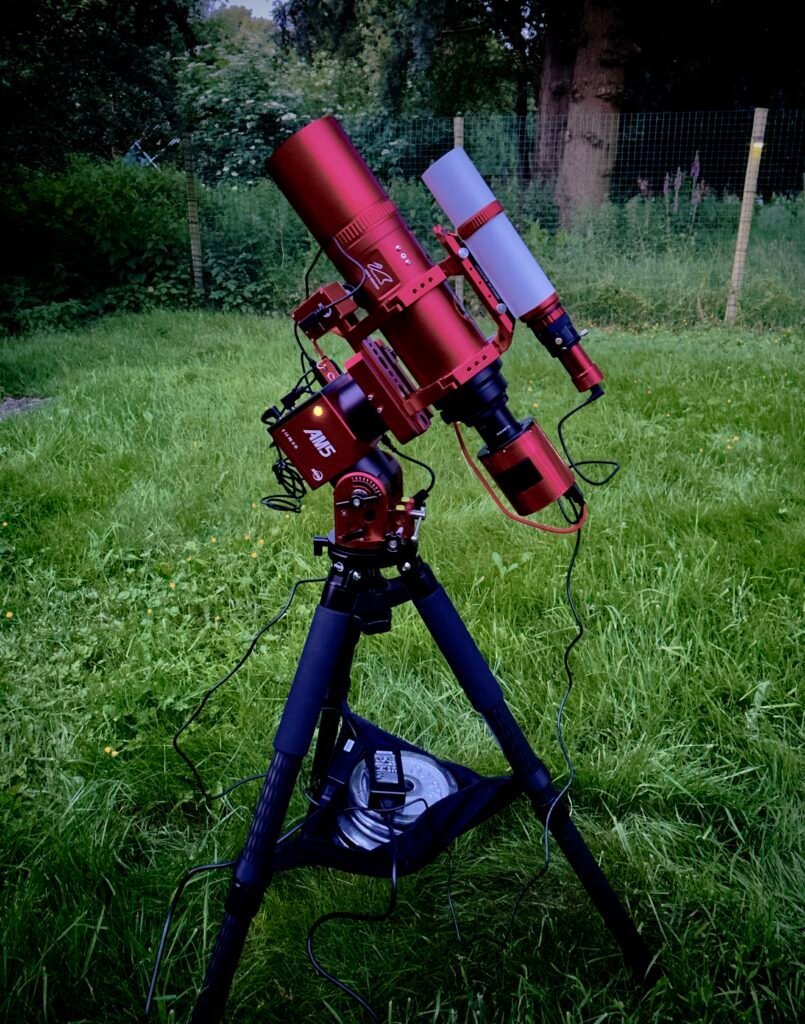
I was off! No idea what I was doing… YouTube was my friend, but I will admit, much of what I was watching just made no sense.
I just did not have enough foundational knowledge to know what I needed to learn first.
So I muddled! And muddled, sometimes it went wrong, sometimes it went right, and sometimes it did not went at all.
But… from this, I found a process: Make a mistake and researched that mistake.
This actually helped a lot, I now was beginning to see what I did not know, and began to fill the gaps.
In two years I would say this process has taken me from an absolute beginner to a beginner 0.5. I am pleased with my progress.
I began to capture images, not great images, certainly not enough of them, but I had captured something! Did you know you needed more than one?
It was in this early process that I learnt about guiding, quite important apparently, who knew?
Focusing! Well, that seemed to help a bit and filters! I was on fire! Skint! But on fire.
On reflection, whilst I am now still convinced that I started with a good scope, I am not convinced that I started with the best camera option.
That’s not to say it is not a good camera, it very much is, but I think my head was turned more by the full frame sensor than anything else.
I became comfortable with my set up, with guidance from some fantastic people, I began to find my feet. The images began to improve, and I was happy with where I was at.
I was at this time processing my images with Sirle, I was getting good results!
good results with 30 images!
One issue I have is my garden faces south, I have a high bank of trees to the East, a low but substantial bank of trees to the West and a house to the North.
This gives me a narrow corridor in which to take images as DSO’s pass by to the South.
Alternatively, I have to wait until I can see a high object which I can spend some time on.
Thank goodness for Cygnus, Cassiopeia and Cepheus!
I was hooked!
Not any good! But hooked, I began to research the night sky, what is out there, can I see it and where is it?
It is at this point I realised I was limited with a 349mm scope, there was a whole other level of objects just beyond the Redcats range.
Getting on really well with Williams Optics, I decided to pull the trigger on the Williams Optics FLT132.
I immediately panicked when it arrived, it’s HUGE! Will me AM5 cope?
Fortunately for me, it does and really well, I found a number of others using the FLT132 with the AM5 so I was filled with confidence I didn’t yet need another mount.

So currently, my setup consists of:
ZWO AM5 Harmonic Equatorial Mount
ZWO 200mm Pier Extension
The Williams Optics FLT132 906mm Scope, William Optics
William Optics FF68III Adjustable Flattener
ZWO ASI 2400MC-Pro OSC
ZWO EAF
ZWO 2″ Filter Drawer
ZWO CCA
Optolong L-eXtreme Light Pollution Dual-Bandpass Filter
William Optics Slide Base 50mm UniGuide Scope
ZWO ASI 120MM Mini USB 2.0 Mono Guide Camera
Dual Channel Dew Controller
2 x W&W Astro Dew Heater
ZWO ASiair Plus 256G
I am still learning!
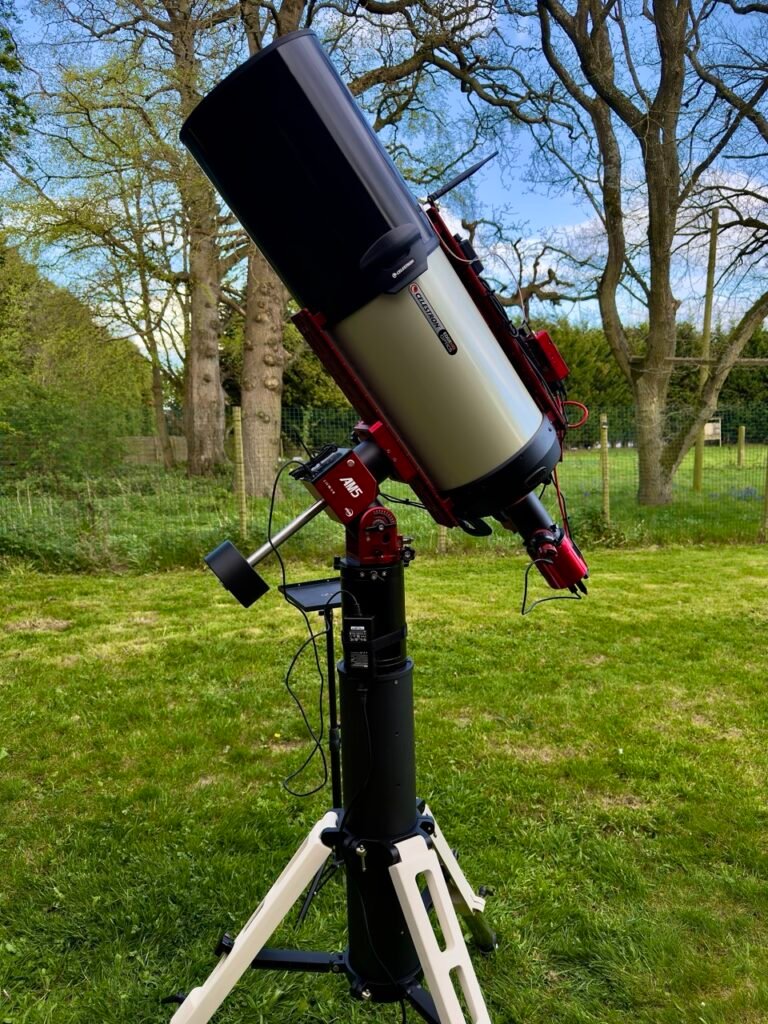
The latest edition to the stable is a HUGE Celestron 9.25″ Edge HD.
This is an Aplanatic Schmidt telescope that has an aperture of 234.95mm (9.25”).
It has a focal length of 2350mm which allows me to look far deeper into space.
I can see more detail of closer images but in the main, it allows me to now target images that were just too far away for the FLT132, it is an excellent Galaxy telescope.
I am still using the ZWO AM5 Harmonic Equatorial Mount and ZWO 200mm Pier Extension but now, this is mounted on an iOptron Tri-Pier for far more stability.
I am still using the ZWO ASI 2400MC-Pro OS Camera which suits this set up really well.
The ZWO EAF, ZWO 2″ Filter Drawer, with a combination of the Optolong L-eXtreme Light Pollution Dual-Bandpass Filter, the Optolong L-PRO Maximum Luminosity Filter and the ZWO Dual Narrowband Filter
The ZWO CCA and guided by the William Optics Slide Base 50mm UniGuide Scope with a ZWO ASI 174MM Mini USB 2.0 Mono Guide Camera.
I have tried an Off Axis Guiding system but so far, I have not got on with it.
My more recent images of Galaxies along with the Eagle Nebula have been taken with this set up.
More to come.